If You Don’t Like the Way Things Are, Start Your Own Country
Even If You Start Your Own Country, That Only Gets You So Far

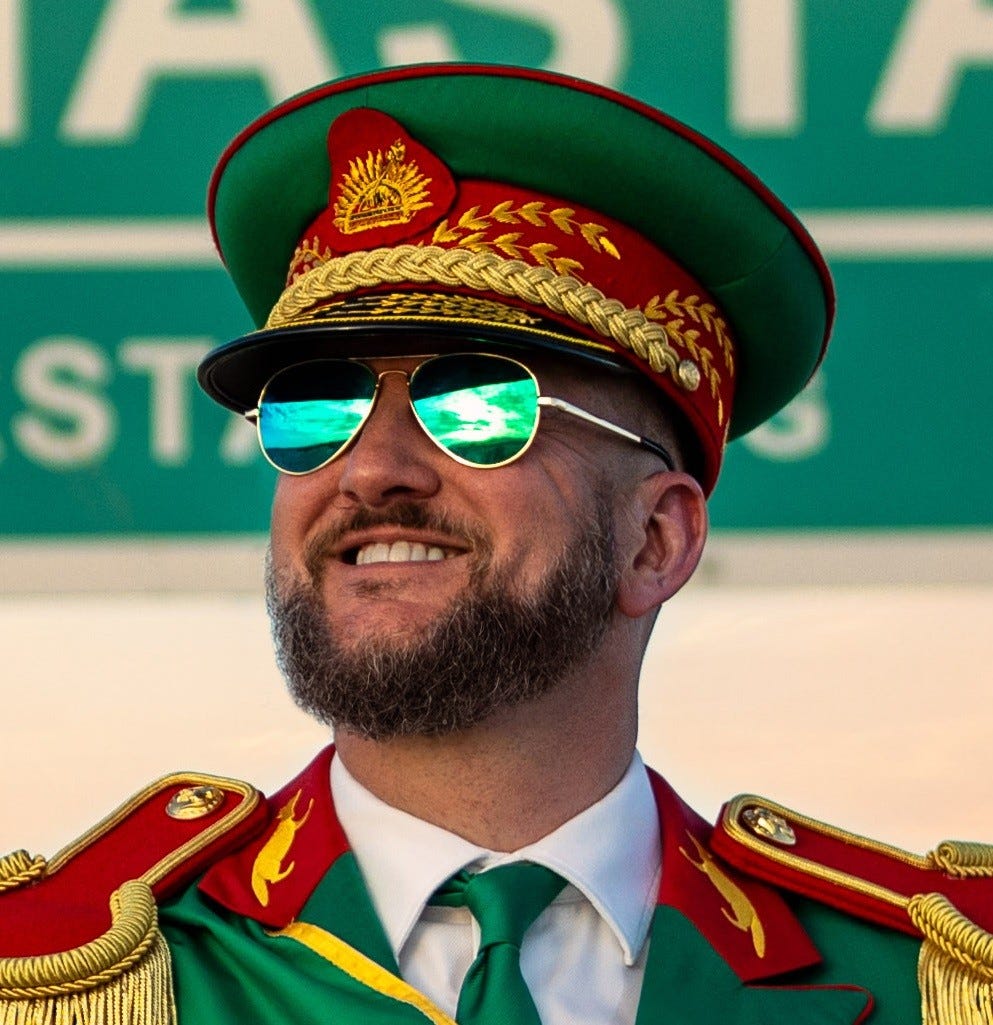
Welcome to the Republic of Slowjamastan
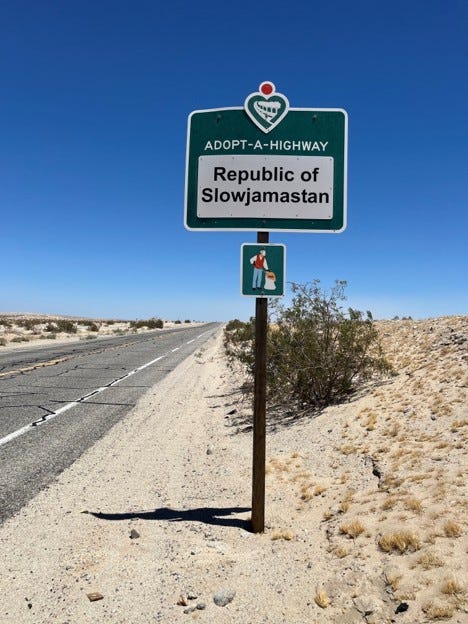
According to Wikipedia, the United Territories of the Sovereign Nation of the Republic of Slowjamastan is a micronation located in Imperial County, Southern California. It was founded on December 1, 2021, by Randy Williams, a San Diego resident, DJ and self-declared Sultan of the Republic. Inspired by the Republic of Molossia (another one-man owned micronation, located in Dayton, Nevada), Williams purchased the 11-acre lot located in an empty plot of desert land in October 2021, 14 miles southwest of the Salton Sea.
Wikimedia continues: “Although Slowjamastan has no structures, on the plot of land is a large border sign by the highway, a border control post and an open desk in Dublandia – the purported capital of Slowjamastan – that serves as the Sultan’s office.”
We visited Slowjamastan this past weekend and I can confirm this summary is correct.
If you visit the website (https://www.slowjamastan.org/), you will find that you can apply for citizenship, a fishing license (bear in mind this nation is located in a full-on desert), a passport and membership in the parliament or an ambassadorship. As of April 2026, they have more than 31,000 citizens, representing over 120 countries.
In an exciting and late-breaking development, the Sultan of Slowjamastan released a music video over this past weekend filmed entirely in Slowjamastan and you can find that video here:
It’s pretty amusing and faithfully captures the look of the place so go have a peak.
If you apply for citizenship and are willing to pay the premium level, you can even have your passport photo posted on the Slowjamastan website for an additional US$19.99. Slowjamastan also recognizes citizenship for cats.
Citizens of Slojamastan are known as Slojamastanis.
According to the Los Angeles Times, Slowjamastan has declared itself independent of the United States. It is not recognized by the Government of the United States nor by other nations. Interestingly, Wikipedia reports the Sultan represented Slowjamastan as a guest at the 2024 NATO summit in Washington, D.C.
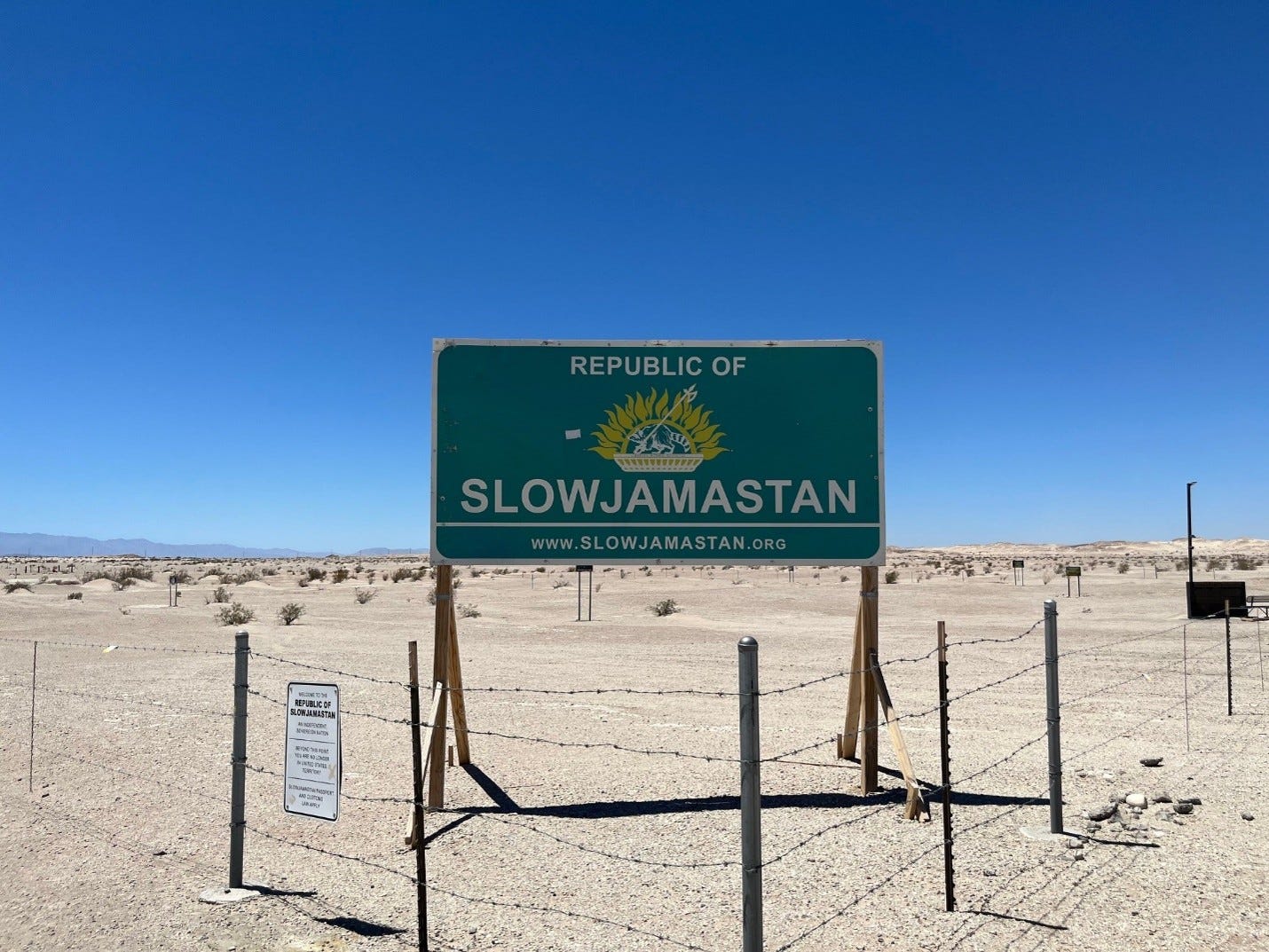
In case your mind goes this way, claiming citizenship will not reduce your legal responsibility to pay applicable local, County, State or Federal taxes in the region surrounding Slowjamastan (I spent way too many professional years dealing with corporate tax departments). The tax situation is my observation as the Los Angeles Times offered no insight as to the tax implications of citizenship.
The Los Angeles Times describes the Sultan’s motives as “half joke, half ongoing performance art by its founder and supreme leader.”
Lest you think forming your own nation will solve much of what you see when you awaken every morning, be aware that the Los Angeles Times reporter visited Slowjamastan in 2025 shortly after two men and two children broke into the border office and stole the mannequin (Ethel) who staffs the tollbooth and spray-painted “We declare war on Slowjamastan.”
I checked the Slowjamastan press website and as yet there is no breakthrough in the criminal investigation of Ethel’s abduction nor the graffiti incident.
You Have Questions:
Is establishing your own micronation a thing? Yes, it definitely is a thing.
Are these micronations officially recognized? Well, it depends what you mean by recognized.
The Montevideo Convention was signed by 17 countries (including the U.S.) on December 26, 1934. President Roosevelt declared this Convention part of the Good Neighbor Policy, which opposed U.S armed intervention in the domestic affairs of Latin America (imagine the U.S. having such a policy).
The driving force behind this Convention was that various national ethnic populations were not recognized by the European empires that formerly controlled them as colonies.
The Convention prohibits the use of force to gain recognition. Wikipedia explains: “the political existence of the state is independent of recognition by other states. This is known as the declarative theory of statehood.”
Article 1 of the Convention states: “The state as a person of international law should possess the following qualifications: (a) a permanent population; (b) a defined territory; (c) government; and (d) capacity to enter into relations with other states.”
Circling back to the Republic of Slowjamastan, as I understand the facts and according to the Slowjamastan Government website, at this point they do not have a population because there are no residents. Its territory is vacant land in the California desert. I can confirm there are no residents and the land remains vacant although I did see an actual mail box on the property with the flag up signifying there was outgoing mail awaiting carrier pick-up.
I don’t know whether Slowjamastan has any interest in entering into relations with other states. According to their Government website, their official international stance is “Don’t start no sh*t, won’t be no sh*t.”
In any event, as a bottom-line matter, they don’t seem to tick all the boxes for recognition under the Montevideo Convention.
And what about the other micronations? According to Wikipedia, there are 80 of them. The exact number fluctuates as some of them come and go. Reviewing the Wikipedia list of micronations, they have been founded for various reasons including historic claims, political protests, immigration claims, for the purpose of bringing lawsuits, in support of indigenous movements, in support of cannabis sales, in support of gay rights, as a front for financial fraud, as art projects, and/or to promote world peace.
The Problem is You Still Have Neighbors
The problem is that as long as your micronation is located on planet earth (and not all micronations are), you still have neighbors and for the most part, their problems are your problems.
If your neighbors have a rat problem or a cockroach problem, you have a rat problem or a cockroach problem.
Likely, if your neighbors have a crime problem, you have a crime problem.
And perhaps most importantly in the neighborhood of Slowjamastan, if your neighbors have an air pollution problem, you have an air pollution problem.
So as much as we tip our hat to the Sultan of Slowjamastan for paying $19,000 in the spirit of the catchphrase “I’m mad as hell and I’m not gonna take it anymore” (from the 1976 motion picture “Network”), yes he’s made a statement and yes 31,000 of his “citizens” agree with him, but when he goes to his office in Slowjamastan (the unstaffed open tollbooth in the desert), the pollution problems of the Salton Sea will permeate the otherwise pristine air of the Republic of Slowjamastan.
Why Slowjamastan Likely has an Air Pollution Problem Even Though It Has No Industry
For those of you just tuning in, the Salton Sea (the closest body of water to Slowjamastan, 14 miles to its northeast) was formed over 100 years ago by mistake in the California Desert when well-meaning (let’s assume they were well-meaning) bumblers redirected the entire Colorado River (fifth largest river in the United States) into a land-locked, below sea-level, basin in the desert and couldn’t make the flooding stop for two years.
You can read the background in my earlier Substack article on this topic (https://lizardgarden.substack.com/p/when-trust-and-dreams-go-too-far), but in fairness, let’s remember the flooding of the California desert occurred the same year as the great San Francisco earthquake of 1906. Maybe people in the engineering world of 1906 were winging it a bit. Maybe the cream of the engineering world was focused on San Francisco. Who knows?
This is just my theory, but I’m guessing California’s State Government was entirely focused on San Franscico so screw-ups in the Imperial Valley didn’t even make their radar.
Currently, the Salton Sea is about 35 miles long and 15 miles wide with an average depth of 20-29 feet. The problem is that the Salton Sea is further drying up every year because it is located in the desert and very little new water is entering the Sea to replenish it. And in the now-exposed sand (that was previously beneath water) are a whole bunch of nasty chemicals.
What Are Those Chemicals and Why Are They Under The Salton Sea?
A paper published by the Public Policy Institute of California explains: “The first problem is that it’s a terminal lake whose inflows are primarily composed of agricultural drainage flows from the Imperial Irrigation District (around 80%) and wastewater from Mexico (around 10%). This set-up leads to an increasingly polluted sea; as the chemical-laden water evaporates, it leaves behind salts and other pollutants such as metals, fertilizers and pesticides.”
How did this come about you ask?
Remember, one of the primary sources of water for the Salton Sea has always been agricultural runoff. In bygone days fertilizers, herbicides and pesticides were largely (maybe totally) unregulated. This included now-banned pesticides like DDT and arsenic. High nitrogen and phosphorus levels in the desert heat create algae blooms. Microbial decay in the oxygen-depleted water causes the rotten-egg smell.
To understand why agricultural runoff is still pouring into the Salton Sea, we need to go back to the 1906 screw-up when the Colorado River poured into the Desert unchecked.
Wikipedia explains: “In 1905, heavy rainfall and snowmelt caused the Colorado River to swell, overrunning the third intake cut into the bank of the river and sending the flood into the Alamo Canal. The resulting flood poured down the canal and down two formerly dry arroyos, the New River in the west and the Alamo River in the east, each about 60 mi (97 km) long. Over about two years, these two newly-created rivers carried the entire volume of the Colorado River into the Salton Sink.”
The rivers (at least two of which didn’t exist before 1905) now carrying agricultural runoff into the Salton Sea are: (1) the Alamo River carrying agricultural runoff from the Imperial Valley, which empties into the southern end of the Sea; (2) the Whitewater River carrying drainage and runoff from the Coachella Valley, which empties into the northern end of the Sea: and (3) the New River carrying urban runoff, partially-treated or untreated industrial and municipal waste, and agricultural waste from Mexicali, Mexico, which also empties into the southern end of the Salton Sea.
By the way, as we drove around the Salton Sea this past weekend, we spotted fertilizer trucks on the road including one labeled “nitrogen.” As noted above, agricultural nitrogen is one of the contributing sources fueling the algae growth on the Salton Sea.
Also, for what it’s worth, the Alamo River was actively flowing yesterday toward its final destination in the Salton Sea. The New River bed (at least the part I saw), looked pretty dry, which could be a seasonal occurrence. Yesterday, in the desert, it was about 100 degrees and sufficiently windy that we had to struggle to maintain our balance as we walked over desert sand dunes.
Were Some of Those Chemicals Already There?
Below the Salton Sea is a naturally occurring geothermal field which is a mixture of elements resulting from tectonic activity and magma. Those naturally occurring chemicals include lithium, zinc, iron, copper, lead and manganese. It also includes calcium, magnesium, salts, sulfur and carbon dioxide. But all that stuff is way below the bottom of the Salton Sea.
For purposes of this discussion, the problem is the chemical crap in the water from the runoff, especially as the water evaporates. According to a study published by the University of California Riverside, the Salton Sea has lost a third of its water in the last 25 years.
What’s That Strange Smell?
A report in the Los Angeles Times explained: “New research has found that the shrinking lake is emitting the foul-smelling gas hydrogen sulfide more frequently and at higher levels than previously measured... Hydrogen sulfide is released as a byproduct of decaying algae and other organic material in the lake, where accumulating fertilizers and other nutrients from agricultural runoff and wastewater feed the growth of algae… Hydrogen sulfide, or H2S, is toxic and studies have found that health effects of exposure at certain levels can include dizziness, headaches, vomiting, cough, chest tightness and depression…”
Chemicals, Shemicals:
In a study undertaken last year by researchers at University of California Irvine and reported in the journal Public Health, they found: “a clear association: Children living near the Salton Sea experienced worse lung function due to their exposure to dust events.”
The study builds on growing evidence that the high particulate matter levels around the shrinking Salton Sea contribute to elevated rates of asthma, wheezing and other respiratory conditions – echoing health disasters such as “Dust Bowl pneumonia” in the 1930s, when widespread dust exposure led to severe and often fatal respiratory illness… This dust can carry contaminants including pesticides, metals and other toxic substances. Communities near the lake, predominantly low-income and Latino, are disproportionately bearing the health burden.”
In another study undertaken last year by the University of California, Riverside, and reported in The Guardian, those researchers reported: “The Salton Sea dust contains high levels of a piece of bacteria membrane that is a high potency endotoxin. The nutrients in the sea are likely causing a proliferation of the bacteria that are leaving behind the membranes.” The Guardian article continues: “The research marks the first time that contaminants have been found to alter the lung microbiome – or bacteria that live in the lungs – that are little understood by health researchers.”
Oh, by the way, The Guardian further reports: “the dust has been found to travel to travel more than 100 miles (160 km), though the prevailing winds blow to the south-east.”
Winds blowing to the southeast of the Salton Sea would first hit the small and economically-challenged towns of Niland, Calipatria and Westmoreland.
To give you context, my husband and I drove through all three towns yesterday and even stopped for a date-shake (made from local dates) in Westmoreland. As I mentioned above, the desert winds were incredibly strong yesterday. I hope we didn’t inhale too much of the contaminated dust, but I felt the visit was important for this article.
Also, according to The Guardian, “similar issues have been reported around the Great Salt Lake in Utah, and other drying Saline lakes.”
I haven’t researched the situation at the Great Salt Lake.
I can confirm what I have seen at the Salton Sea which is populated with wonderful, hard-working and extraordinarily creative people. The agricultural folks actively continue with their mission of growing crops (as we depend upon them to do), the agricultural runoff continues into the Salton Sea, and scientists tell us the hot dry desert air continues carrying the particles into the lungs of people who live within 100 miles and breath that air.
In the vernacular, the ongoing airborne chemical dispersal situation is no bueno. I admire the Sultan for his decision to start his own country, but if pollution goes airborne, it won’t be stopped at the passport control desk.
Isn’t Somebody Doing Something?
In one of the very good documentary films about the Salton Sea, “Miracle in the Desert: The Rise and Fall of the Salton Sea,” a commentator remarks, to the effect, the people who would pay the cost of fixing the Salton Sea pollution problem (meaning legislators in Sacramento) are not the people who bear the cost (meaning the people downwind of the 65,000 acres of exposed sand).
Moreover, as another commentator observed, the longer we wait, the worse the problem and the higher the cost. Another commentator speculated that as of 2018, the State of California had advanced 3% of the funding originally promised in 2008-2009 for remediation of the Salton Sea.
As to what has happened lately, the State of California adopted the Salton Sea Management Program in 2018 which includes a 10-year management program. The program contemplates spending $383 Million towards wildlife habitat creation and dust suppression across 30,000 acres. On April 10, 2026, Governor Newsom announced the creation of the State’s new Conservancy to oversee both the long-term plan as well as State and Federal funding.
Will the Conservancy be successful? Will the promised funding arrive? Even if the funding arrives, will the plans work as hoped?
The Salton Sea, as one commentator put it, is a mysterious and confounding place.
Some are hoping that the solution lies in the brine beneath the Salton Sea. Perhaps that is the answer (or part of it), but as they say, the devil lies in the details.
We really do need to talk further about lithium mining, Hell’s Kitchen and potentially increasing the risk of earthquakes at the Salton Sea. Interestingly, the Salton Sea also has a migrating geyser (yes, you read that correctly) and we’ll cover that in the next article.
This is the third in a series of articles about our family visits to the Salton Sea, the extraordinary people who live there and the need to think deeply about the future of this place so we don’t have a modern-day replay of the disasters of 1900 (or worse).
The first article covered some of the early history of the Salton Sea and my great grandfather’s life there at the beginning of the last century. You can find that article here: https://lizardgarden.substack.com/p/when-trust-and-dreams-go-too-far
The second article covered promotion of the Salton Sea as the new riviera in the California desert, the art scene flourishing now, and the environmental impact of the evaporating water. You can read that article here: https://lizardgarden.substack.com/p/visit-to-the-last-free-place
Be on the lookout for the Fourth installment of this story.
Sources: Audubon.com, Bloomberg, Californiathroughmylens.com, Calexico Chronicle, calmatters.org, CNBC.com, Desert Oasis Insider, insideclimatenews.org, The Los Angeles Times, The New York Times, newsweek.com, Public Policy Institute of California, San Diego Union Tribune, sfgate.com, The Guardian, theweek.com, themodernpostcard.com, Wikipedia.